

- This event has passed.
Keith Haring at The Brant Foundation (NYC)
Guided Tour: Tuesday, March 24 at 2pm
$35 for members, $45 non-members
(Space is limited)
Tour will last approximately one hour. Register below and meet us at The Brant Foundation (421 East 6th Street, NYC) at 1:50pm.
 Join The Carriage Barn Arts Center for an exclusive group tour at The Brant Foundation’s East Village location (421 East 6th Street), the downtown neighborhood where a young Haring began his career.
Revisiting Haring’s formative years of 1980–1983, the exhibition traces his meteoric rise from the subways of New York to international fame.
Keith Haring (American, b. 1958, d. 1990) remains one of the most celebrated and influential figures in American art, renowned for breaking traditional art world boundaries and transferring the energy of the East Village’s streets to galleries. Emerging from the downtown New York subculture of the early 1980s, Haring took inspiration from the everyday urban spaces he inhabited. From his spontaneous, early-career chalk drawings in subway stations, to his vibrant, pop-inspired works that addressed social issues ranging from the AIDS epidemic to the drug crisis, Haring shepherded a body of work that was both visually dynamic and socially engaged.
Curator Dieter Buchhart cites the timelessness of Haring’s work as inspiration for the exhibition, stating, “Like a positive humanist virus, Haring’s urban guerrilla art lives on in our collective memory, fighting against ignorance, fear, and silence. His humanist code resonates with a universality that transcends time and place. And in the spirit of today’s Emoji euphoria, we might well proclaim: For better or worse, we are all speaking Haring now.”
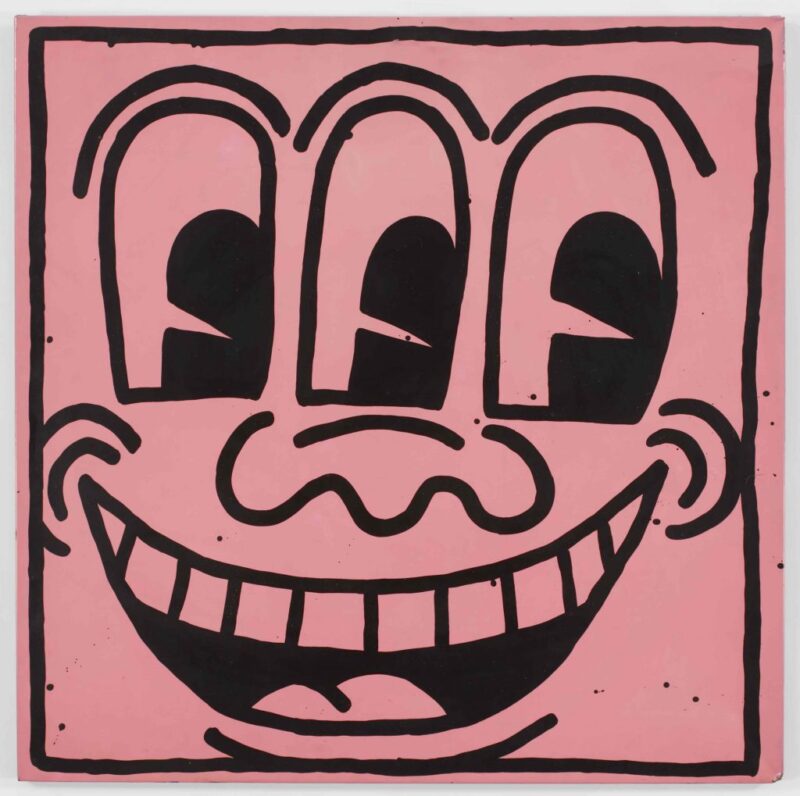
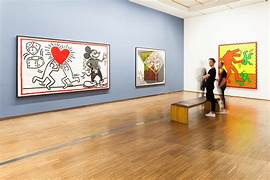 Throughout his career, Haring crafted one of the most recognizable and celebrated artistic styles with a series of iconic symbols, themes, and motifs that permeated his work. It was this instantly identifiable and exuberant quality that helped drive the artist’s career. Crafted with baked enamel on metal, his 1981 untitled work showing a pink smiling face serves as a predecessor to the digital age with its emoji-like iconography, highlighting Haring’s desire for a universal system of communication. Haring’s frequently repeated symbols were a constant throughout his work, which developed its own – almost geometric – language. In another untitled work from 1981, the artist’s trademark dogs are seen in a scene filled with rhythm and infectious energy. Often acting as lively companions or symbolic messengers, the dogs embody a playful pleasure in the show of shared experience. Surrounded by signature, energetic lines, the composition itself seems to vibrate with life. Haring’s mastery of space through line is demonstrated in the artist’s 1982 untitled work, depicting a psychedelic Mickey Mouse, through his ability to capture movement and subversive energy in fluid, uninterrupted ink strokes. The painting stands out as an example of his playful takes on distinctly American imagery, a recurring aspect of not only Haring’s works, but Neo-Expressionists and Pop artists working in the same period like Jean-Michel Basquiat, Kenny Scharf, and Andy Warhol.